Disclaimer: This article is general information for dog owners, not veterinary advice. Every dog is different, so check with your vet or groomer about your own dog.
Trimming dog nails at home is one of those jobs many owners put off, often because their dog dislikes it or they worry about cutting too short. With the right tools, a slow introduction and a simple routine, it can become a quick, low-stress part of regular care. Nails that are kept at a comfortable length may help your dog walk and grip more naturally, especially on smooth floors.
This guide covers the tools to have ready, how to help your dog feel comfortable with paw handling, a step-by-step trimming routine and the signs that it is time to hand the job over to a groomer or your vet.
Signs your dog’s nails may need attention
Every dog’s nails grow at a different rate, depending on age, activity and the surfaces they walk on. Instead of following a fixed schedule, watch for these everyday clues.
- You can hear clicking on hard floors as your dog walks.
- Nails touch the ground when your dog is standing still.
- Your dog seems to slip more than usual on smooth surfaces.
- Dewclaws, the nails higher on the inside of the leg, are curving toward the skin.
- Nails are catching on carpet, bedding or clothing.
If you are not sure what a comfortable length looks like for your dog, ask your vet or groomer to show you at your next visit.
Tools for trimming dog nails at home
Having everything ready before you start keeps sessions short and calm. Here is a simple kit.
- Clippers or a grinder: Scissor-style or guillotine-style clippers suit many dogs. A nail grinder files the nail down gradually and some owners find it easier to control. Choose a size that fits your dog’s nails.
- Styptic powder: Keep a small container nearby in case a nail bleeds. Ask your vet which product they recommend.
- Good lighting: A bright lamp or daylight makes it easier to see the nail clearly.
- High-value treats: Small, soft treats your dog loves help turn nail care into a positive experience. See our guide to healthy dog treats.
- A non-slip surface: A mat or towel on the floor or table helps your dog feel steady.
- A helper: For wriggly dogs, a second person can offer treats and gentle support.
Our article on essential dog grooming tools covers more options for building a home kit.
Help your dog get comfortable with paw handling
Many dogs dislike nail trims because having their paws held feels strange. Spending a few days on handling practice before you ever pick up the clippers can make a big difference.
- At a calm moment, touch one paw briefly, then give a treat. Repeat a few times and stop.
- Gradually hold the paw for a little longer, still pairing each touch with a reward.
- Gently press each toe so the nail extends slightly, then reward.
- Show your dog the clippers or grinder, let them sniff, and reward. If you are using a grinder, switch it on at a distance first so they get used to the sound.
- Touch the clippers to a nail without cutting, then reward.
Move to the next step only when your dog is relaxed. If they pull away, lick their lips or stiffen, go back a step. Learning to read your dog’s body language helps you pace this well.
Step-by-step: trimming dog nails at home
Once your dog is comfortable with handling, you are ready for a real trim. Keep the first sessions very short. Trimming one or two nails and stopping on a good note is a success.
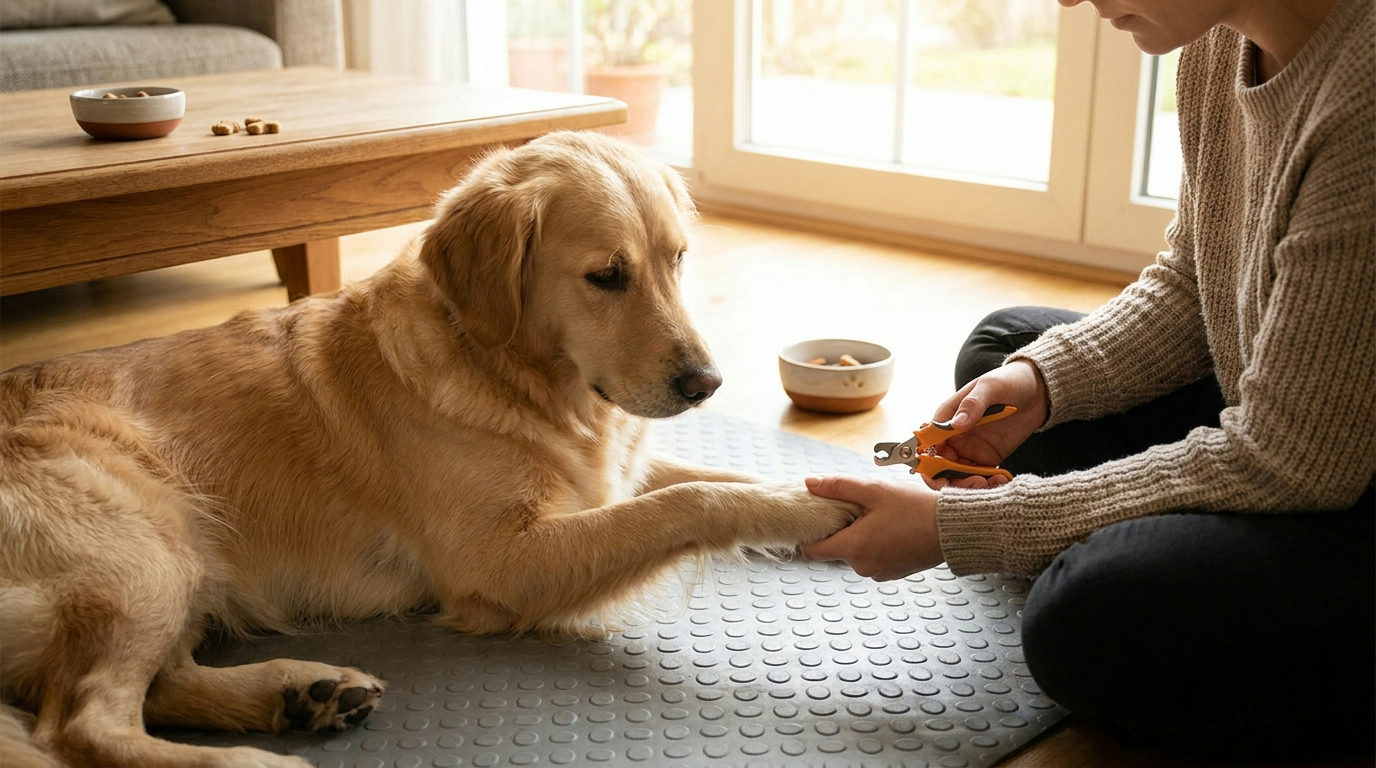
- Get comfortable: Sit on the floor with your dog, or have a small dog on a steady, non-slip surface.
- Hold the paw gently: Support the paw without squeezing, and press the toe pad lightly to extend the nail.
- Find the quick: The quick is the living part inside the nail that contains blood vessels and nerves. On light-colored nails it often shows as a pink area. On dark nails it is harder to see, so trim tiny slivers at a time.
- Trim a small amount: Cut only the tip, at a slight angle, well away from the quick. When in doubt, take less.
- Check the cut surface: On dark nails, many owners stop when a small, darker dot appears in the center of the cut surface, as this may mean the quick is close.
- Reward and pause: Give a treat after each nail. Take breaks whenever your dog needs one.
- Do not forget dewclaws: These do not touch the ground, so they can grow longer than the others.
- Smooth rough edges: A nail file or grinder can soften sharp edges if needed.
If you do nick the quick, stay calm. Apply styptic powder with gentle pressure and give your dog a break. If bleeding does not stop, contact your vet.
Clippers or grinder: which suits your dog?
There is no single right tool. Many owners try both and settle on whichever their dog tolerates best.
- Clippers are quiet and quick. They work well when you can see the nail clearly and your dog stays fairly still for a moment.
- Grinders take off a little at a time and leave a smoother edge. They make a buzzing sound and some vibration, so they need a slower introduction.
- Combining both is common: a small clip to shorten the tip, then a light grind to smooth it.
- Long fur on the paws should be held back or trimmed so it cannot catch in a grinder.
Whichever you choose, keep blades sharp and the tool clean, as dull clippers can crush rather than cut.
Building a regular routine
Short, regular sessions are usually easier for both of you than occasional long ones. These habits help keep nail care on track.
- Pick a calm time of day, such as after a walk when your dog is relaxed.
- Do a quick paw and nail check once a week, even if you do not trim.
- Trim a little more often rather than a lot at once.
- Keep the kit together in one box so it is always ready.
- End every session with a favorite treat or game.
Regular walks on varied surfaces can also help, and good walking gear makes those outings more comfortable.
When a groomer or vet may be the better choice
Trimming dog nails at home is not right for every dog or every owner. It is perfectly reasonable to ask for help in these situations.
- Your dog becomes very stressed, panics or tries to bite during handling.
- All of your dog’s nails are dark and you cannot judge where the quick is.
- Nails have become very long and you are unsure how much to take off.
- A dewclaw is curling toward or into the skin.
- You simply feel more comfortable watching a professional first.
Many groomers and vet clinics offer quick nail trims, and some are happy to show you how to do it yourself next time.
When to call your vet
Contact your vet if you notice any of the following:
- Bleeding from a nail that does not stop with gentle pressure and styptic powder.
- A cracked, split or broken nail.
- Swelling, redness, discharge or a bad smell around a nail or toe.
- Limping, licking or chewing at a paw.
- Changes in nail color, shape or texture.
- A dewclaw that has grown into the skin.
Questions to ask your vet
- What is a comfortable nail length for my dog?
- How can I tell where the quick is on my dog’s dark nails?
- Would clippers or a grinder suit my dog better?
- Which styptic product do you recommend keeping at home?
- My dog is very anxious about nail trims. What options could help?
Small steps add up
Trimming dog nails at home gets easier with practice, for you and your dog. Start with handling, keep sessions short, reward generously and take only a little at a time. If you ever feel unsure, a groomer or your vet can help, and there is no prize for doing every nail in one go. Over a few weeks, most dogs learn that paw handling simply means treats, and the whole job starts to take just a few minutes.
Further reading
- American Kennel Club: How to trim your dog’s nails at home
- VCA Animal Hospitals: How to trim a dog’s nails
- PDSA: How to clip your dog’s nails