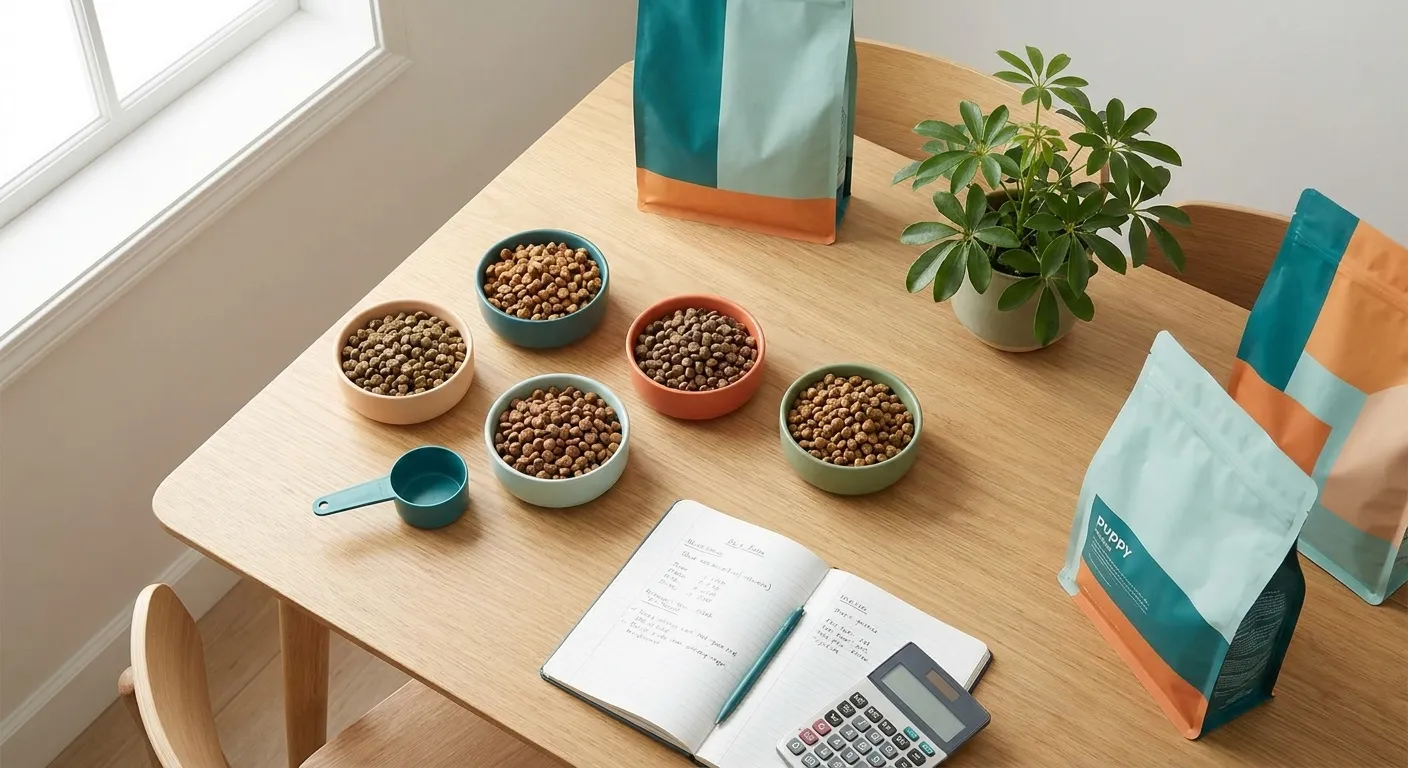
This affordable puppy food guide starts with two questions: does the food suit your puppy, and what does it cost to feed under the plan agreed with your veterinary team? A low bag price answers neither question by itself. You can compare labels and costs without choosing a product solely because it says premium, natural or budget-friendly.
The guidance here is educational, not veterinary advice or a substitute for a nutritional assessment. Ask your veterinarian about your puppy’s diet, portions and any feeding change, especially when illness or growth concerns are involved. No brand or universal feeding quantity is recommended. All prices and portions in examples are hypothetical, used to explain arithmetic rather than tell you what to feed.
Start with your puppy’s information
Write down age, current food, feeding amount and the questions you want to ask at the next veterinary visit. Include any treats, supplements or other foods so the discussion reflects what the puppy actually eats. If there are concerns about appetite, stool, growth or comfort, describe the observations rather than diagnosing a nutritional problem yourself.
Ask whether any specific dietary requirements affect your shortlist, including expected adult size where relevant. Keep the answer with your shopping notes. A budget comparison should happen within a suitable set of choices, not override a veterinary plan. If the puppy is already receiving a medically directed diet, consult the treating team before substituting another product to reduce the bill.
Find the nutritional adequacy statement
The FDA explains complete-and-balanced pet food and the importance of the nutritional adequacy statement. It distinguishes growth and reproduction from adult maintenance. Read the actual statement rather than assuming a picture of a puppy or a front-panel slogan establishes suitability for a growing dog.
Copy the statement exactly into your comparison notes or photograph the relevant panel. If a growth-related limitation appears, ask your veterinarian how it applies to the puppy. Treats, supplements and products labeled for intermittent feeding should not silently replace the main diet. If the statement is missing or confusing, ask the manufacturer and veterinary team for clarification before relying on the product.
Look beyond a reassuring ingredient story
An attractive ingredient description can contribute information without establishing that the whole diet meets the puppy’s needs. Avoid ranking food using one ingredient, a higher price or a vague claim about avoiding fillers. Ask what evidence supports the manufacturer’s product and how the formulation is assessed.
The WSAVA food-selection toolkit identifies useful questions about formulation expertise, quality-control processes and product research. Use those questions to contact the company rather than inventing a quality score from the ingredient list. Keep actual answers with the shortlist. The toolkit is a framework for inquiry, not a personal recommendation for a brand your puppy has not been assessed for.
Compare quantities using the same units
Record package weight, price and any delivery charge. Convert quantities consistently before calculating a unit cost. A smaller bag with a lower sticker price may cost more per kilogram, while a larger bag can require more money upfront. Neither result settles whether the product is suitable or whether the household can use the amount appropriately.
For illustration, an invented two-kilogram bag costs $16 and a five-kilogram bag costs $35. Their package costs are $8 and $7 per kilogram before other charges. If you compare a weight-based figure with a price per can, pause and define the unit. Keep dry and wet product comparisons explicit rather than treating package size alone as a measure of nutritional value.
Calculate daily cost from an agreed feeding plan
Use the portion information discussed with your veterinarian and the product’s actual calorie or serving information. Do not assume equal scoop sizes or equal daily gram amounts make unlike diets equivalent. If the needed information is missing, ask the manufacturer. The purpose is to calculate costs for a suitable plan, not derive your puppy’s nutritional requirements from price.
Suppose the veterinary plan for a hypothetical puppy uses 200 grams daily of an example food. A two-kilogram bag would cover ten days, ignoring waste for this arithmetic exercise. At an invented $16 per bag, that is $1.60 per day. A different food may require a different portion; repeat the calculation with its own agreed plan. The 200-gram figure is not a feeding recommendation.
Add delivery, waste and practical storage
If delivery costs $4 on that hypothetical bag, the known total becomes $20 and the example daily cost becomes $2.00. Check whether recurring orders, payment methods or minimum quantities alter the price. Read the actual conditions rather than assuming a discount applies to every purchase or remains unchanged.
Also consider whether the package size fits the manufacturer’s storage and use instructions. A theoretical unit saving is unhelpful if you cannot store or use the food as directed. Do not combine old and new batches in a way that loses lot information. Keep the package details and manufacturer’s instructions available rather than decanting without a record of what was purchased.
Ask about availability before committing to a plan
Find out where you can reliably obtain the chosen product and what lead time a normal order requires. This is a logistical question, not a prediction about shortages. A plan that depends on one delivery route should include how you would obtain advice if a reorder is delayed or the product is unavailable.
Avoid substituting a different formula solely because the packaging looks similar. Product names and life-stage statements matter. Discuss a suitable alternative with your veterinary team when necessary, and keep the chosen details in writing. Do not create a homemade replacement or add supplements without appropriate professional guidance merely to extend a bag.
Discuss any transition with your veterinarian
If a change is appropriate, ask the veterinary team for a plan for this puppy. This article does not prescribe a universal transition duration or mixing schedule. Keep the old and new product names, feeding amounts and timing instructions clear so everyone in the household follows the same plan.
Record relevant observations during a change and contact the veterinarian about concerns. Do not assume a symptom proves an ingredient allergy or that another immediate switch will solve it. A feeding log can support the conversation without becoming a diagnosis. If the puppy appears unwell, veterinary assessment takes priority over completing a price comparison.
Keep treats and extras visible in the budget
List treats, chews, toppers and supplements alongside the main diet. Ask the veterinary team how they fit the feeding plan. A bag-price comparison can miss substantial spending on extras, and an apparently balanced main diet should not be treated as permission to add unlimited supplementary food.
Review whether each extra has a clear purpose and is appropriate for the puppy. This article does not set a treat allowance or recommend supplements. Avoid products making unsupported growth, immunity or digestive promises. Budget planning can help identify optional purchases to discuss without compromising the main diet’s suitability or replacing professional advice.
Finish with a suitable shortlist
An affordable puppy food guide should leave you with documented adequacy statements, manufacturer answers and daily costs based on an appropriate feeding plan. Compare a small number of suitable options and bring unresolved questions to your veterinarian. Keep the final choice and portion instructions accessible to everyone who feeds the puppy.
Affordability means understanding the ongoing cost without assigning quality from a slogan or sticker price. Revisit the plan as your puppy grows and circumstances change, with veterinary guidance. A clear worksheet can make shopping less confusing, while the puppy’s individual needs remain central to the decision.