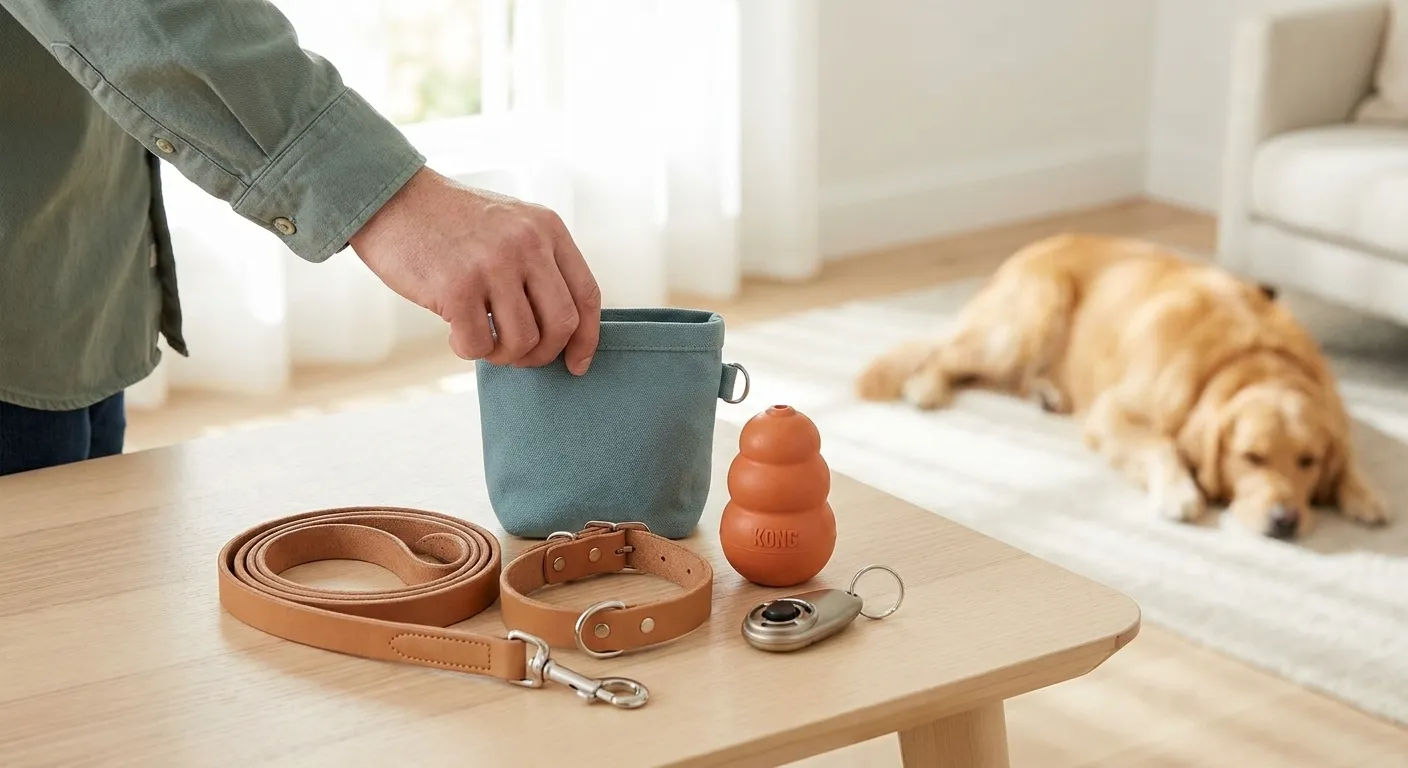
Practical dog training gear should help you carry out a clear, humane plan. A comfortable attachment, a reliable leash and a way to deliver rewards may be more useful than an elaborate gadget you cannot explain. The point is not that the cheapest tool always works best. It is that each item should have a specific role, fit the dog and be straightforward for the handler to use.
This is educational guidance, not veterinary advice or a substitute for individual behavioral assessment. Seek professional help for fear, aggression, pain or safety concerns. No particular product is recommended. Tools do not guarantee a trained dog, and changing equipment alone may not address the behavior you are seeing.
Begin with the skill, not the shopping cart
Choose one ordinary skill you want to practice, such as calmly joining you at a doorway or responding to a cue in a quiet room. Describe the desired action in observable terms. Then ask which item helps you arrange the practice or deliver a reward. Avoid buying several tools because an advertisement promises complete obedience.
Keep the environment and difficulty manageable. A piece of equipment cannot turn an overwhelming setting into an appropriate lesson by itself. If the dog struggles, consider the task, surroundings and professional guidance before adding another device. Your notes should connect the item to a real job rather than a broad hope that more gear produces faster progress.
Use a reward-based approach
The American Veterinary Society of Animal Behavior’s humane-training statement recommends reward-based methods and advises against aversive methods. Choose tools that support that approach rather than relying on pain, fear or intimidation. A tool sold as quick or effective still needs to be assessed by how it is used and what experience it creates for the dog.
A reward may involve suitable food, play or another activity the dog enjoys, under an appropriate plan. Ask your veterinary team about dietary limits when food rewards are involved. Do not assume praise is equally rewarding in every situation or that a treat can override distress. Professional guidance can help you choose an achievable task and appropriate reinforcer.
Check the collar or harness as equipment
Read the manufacturer’s sizing and fitting instructions for the exact model. Check whether the fasteners are easy to operate and secure, and inspect the material and stitching. Ask a qualified professional for help if fit or handling is uncertain. This guide does not prescribe one universal fit rule or declare one shape suitable for every dog.
Before a practice session, look for damage, twisted straps or an attachment that did not close properly. Watch for discomfort and stop using an item that seems unsuitable while seeking advice. A familiar brand name cannot replace a check of the actual piece in your hand. Fit and condition should be reviewed as the dog grows or circumstances change.
Pick a leash for the actual setting
Consider where you will practice, how you will hold it and what the equipment instructions permit. Check the clasp, handle, material condition and suitability for the dog’s size. A product’s advertised strength is not a reason to skip inspection or use it outside its stated purpose. Avoid assuming an unusually long line is appropriate for a crowded area.
Practice handling without creating unnecessary tangles. Keep away from situations where the line could entangle people or animals, and seek instruction when learning a new setup. The leash can support management while you teach; it is not a reason to drag or jerk the dog into an action. If you need more control than the current plan provides, get professional guidance.
Make rewards easy to access
A washable pouch or an existing suitable container can make preparation simpler. Choose one that you can open reliably without dropping items or fumbling with unrelated objects. Consider how it attaches, how it closes and how you will clean it according to instructions. An expensive accessory is unnecessary if the existing setup works safely and consistently.
Prepare only appropriate rewards and keep them securely out of reach between sessions. Ask your veterinarian how food rewards fit the overall diet. The pouch does not need to hold a large supply simply because it can. A clear routine should help the household track what is used rather than hide extra feeding in a training session.
Decide whether a marker tool solves a problem
Some plans use a clicker or a consistent verbal marker to identify the action being rewarded. If you use a clicker, learn the method from a qualified reward-based trainer and consider whether the sound suits the dog. The device itself does not teach the skill. Consistent use within an appropriate plan is the relevant question.
If handling a leash, pouch and clicker is awkward, discuss a simpler arrangement. Avoid adding tools until you understand their jobs. Practice the handler sequence without increasing the dog’s task difficulty, and keep the session manageable. A small item can be helpful, but it should not turn practice into a coordination problem you cannot comfortably perform.
Use a mat as a defined practice location
If your plan involves settling on a mat, choose a surface suitable for the dog and setting. Check that it stays in place and can be cleaned as instructed. Keep the location away from unnecessary disruption. The mat is a cue or practice area within the plan; it is not a guarantee of calm behavior.
Do not force the dog to remain on it or use it to trap the dog in an uncomfortable situation. Ask a trainer how to introduce the task gradually and reward the desired action. Review whether the surface or location is creating a problem before assuming the dog needs firmer handling. A different setup may be more useful than a more elaborate product.
Separate management from training
A barrier, leash or appropriate setup can help organize the environment while a skill is learned. It does not necessarily teach the future response by itself. Explain which part of the plan prevents an unwanted situation and which part reinforces the action you want. Keep everyone in the household consistent about that distinction.
Check any barrier’s instructions, stability and suitability for the dog. Do not rely on it as a universal answer to serious behavioral or safety concerns. If the dog is distressed, escapes or reacts aggressively, seek qualified help rather than treating the equipment as a treatment. Management should fit an individual plan and be revisited when it is not working.
Keep a simple practice record
Write the skill, setting, equipment and what happened. Include whether the dog engaged comfortably, whether handling was awkward and which question needs professional input. A record can help you see that changing the task or environment may matter more than replacing the gear. Avoid claiming a fixed number of sessions will produce a particular result.
Review purchases after you have identified a specific limitation. A damaged clasp needs attention; a pouch that repeatedly spills needs a different arrangement. A difficult behavior may need assessment rather than shopping. Practical dog training gear earns its place by supporting a humane, understandable process. Keep the kit small enough to use clearly, and let the dog’s welfare and actual task guide the next decision.